Running AI for Finance
Most finance dashboards fail because the AI has no memory. Here's how to build a structured data layer that turns Claude into a reliable finance reporting engine.
Most finance dashboards fail for one reason.
The AI has no memory.
It sees disconnected spreadsheets, fragmented exports, CRM data, payroll systems, QuickBooks, and random CSV uploads. Then people wonder why the answers hallucinate.
The problem is not Claude. The problem is your architecture.
Over the last few weeks, we built an internal finance reporting system that lets Claude answer operational and financial questions with real underlying ledger data, projections, hiring plans, CRM pipeline information, and revenue models.
An accountant joined the company on Monday. By Wednesday, he had interactive finance dashboards with clickable metrics, runway analysis, revenue breakdowns, headcount tracking, and forecasting.
The reason this worked was not magic. It was infrastructure. Here’s the exact setup.
Step 1: Stop Treating AI Like a Spreadsheet Assistant
Most people upload files into Claude and ask questions directly. That works for summaries. It breaks for finance operations.
Finance reporting requires:
• Historical memory
• Structured data
• Source traceability
• Forecasting logic
• Consistent relationships between systems
Instead of letting the LLM “guess,” you need to reconstruct a structured view of the business first. Think of it as building a finance knowledge graph.
Every customer. Every ledger line. Every employee. Every contract. Every payment. Every projected deal. Connected. Structured. Queryable.
Then Claude becomes useful.
Step 2: Centralize Your Data Into One Finance Layer
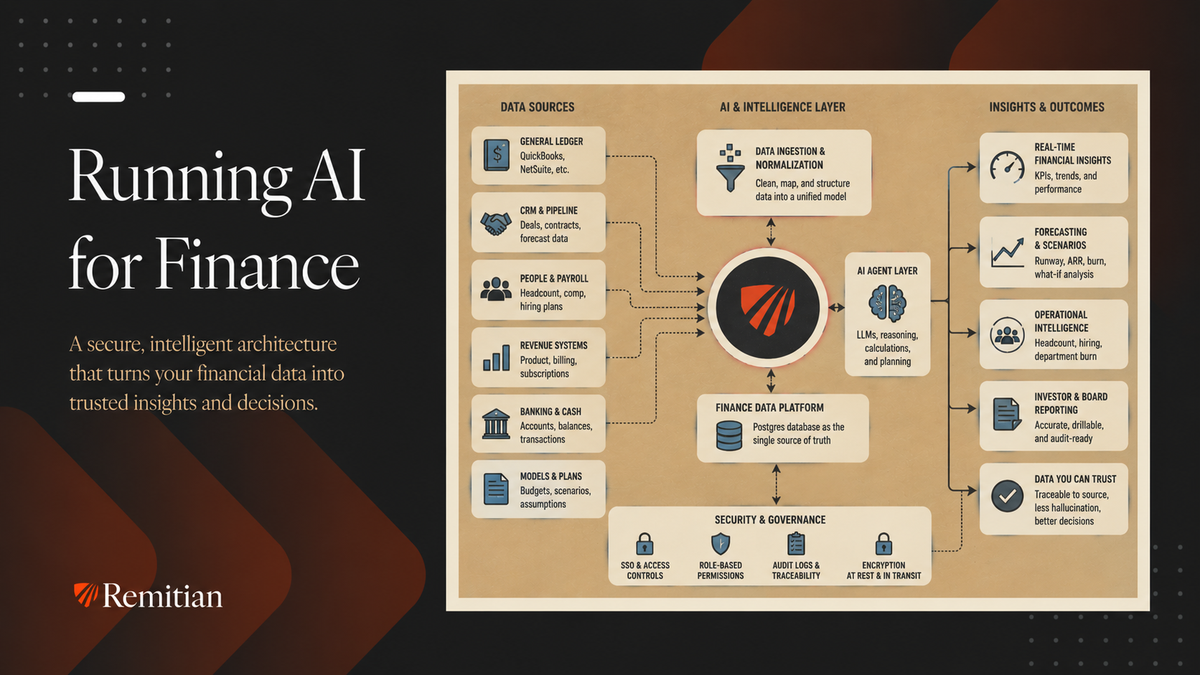
Your finance reporting stack should aggregate data from:
• QuickBooks or NetSuite
• HubSpot or Salesforce
• Payroll systems
• Product revenue systems
• Banking data
• Forecast assumptions
• Hiring plans
The key insight: Do not query production systems directly with the LLM. Instead, pull snapshots from every source, normalize the data, store it in a structured database, and let Claude query the structured layer.
This dramatically reduces hallucinations. Because Claude is no longer generating answers from words. It is generating answers from actual ledger data.
Step 3: Use Postgres as the Memory Layer
The architecture we used was intentionally simple: PostgreSQL, Python/FastAPI, React, Claude/OpenAI/Gemini as interchangeable LLM layers, hosted in AWS with infrastructure-as-code deployment.
Why Postgres? Because finance data is relational. Revenue connects to customers. Customers connect to contracts. Contracts connect to forecasts. Forecasts connect to hiring plans.
You need structure. Not a giant vector database full of PDFs. The AI agent should have memory. That memory lives inside your database.
Step 4: Create Financial Snapshots
This was the breakthrough. Instead of querying live systems constantly, we created periodic “financial snapshots.”
Each snapshot contains:
• Actual revenue
• CRM pipeline
• Forecasted deals
• Headcount and burn
• Cash balances
• Payment schedules
• Contracts and hiring assumptions
Every snapshot becomes a frozen financial state of the business. That allows forecasting, scenario analysis, historical comparisons, board reporting, runway tracking, and investor reporting — without ambiguity.
Step 5: Make Every Metric Clickable
This part matters more than people think. If your dashboard says “Headcount: 30” — you should be able to click it and immediately see every employee, cost allocations, department mapping, planned hires, and compensation assumptions.
Same for revenue, gross margin, burn, runway, pipeline, and forecasted ARR.
Visibility reduces hallucination risk. Users trust systems when they can trace answers back to source data. The AI should never operate as a black box.
Step 6: Separate AI From the Orchestration Layer
A major mistake companies make: they tightly couple the LLM to the system. Don’t do this.
Instead, use Python services as orchestration layers. Store secrets securely. Swap models independently. Route different jobs to different LLMs:
• Claude for reasoning
• OpenAI for structured outputs
• Gemini for long-context processing
Your orchestration layer handles permissions, database access, APIs, webhooks, sync jobs, access control, and MCP integrations. The LLM is only one component, not the system itself.
Step 7: Prioritize Security From Day One
The first production question should not be “What dashboard should we build?” It should be “How do we secure this?”
Your finance AI stack needs:
• SSO and role-based permissions
• Audit logs
• Secure infrastructure
• Internal cloud deployments
• Encryption at rest and in transit
For enterprise environments, run the LLM through Azure OpenAI or internal cloud infrastructure instead of exposing sensitive data externally , especially for multinational finance environments.
Step 8: Start Manual Before Automating
Most teams over-engineer immediately. Don’t.
Start with manual uploads. Build the structure first. Then automate sync agents later. Once your schema works, automate CRM sync, ledger sync, payroll ingestion, and forecasting updates.
The automation layer comes second. The data model comes first.
Step 9: Understand Why This Reduces Hallucinations
This is the core insight. Claude hallucinates less when:
• Data is structured
• Relationships are explicit
• Source records are accessible
• Metrics are traceable
• The AI queries databases instead of raw language
You are effectively reconstructing a digital model of the business. The LLM is not inventing reality. It is interpreting a structured representation of reality. That changes everything.
Step 10: The Stack Is Simpler Than You Think
A lot of executives assume this requires massive infrastructure. It doesn’t. A small team can build this in weeks if the cloud foundation already exists.
The stack: PostgreSQL, Python, React, cloud infrastructure, and AI APIs.
The real work is data modeling, security, workflow design, permission structures, financial logic, and forecast assumptions. The AI part is the easy part.
What This Looks Like in Practice
Once operational, your finance team can ask:
• What is our projected runway if we hire 5 engineers next quarter?
• Which customers drive the highest gross margin?
• What revenue is tied to deals currently in CRM?
• How does projected ARR compare to historical growth?
• Which departments increased burn month-over-month?
• Which clients are at risk based on payment timing?
And Claude can answer instantly. With traceable underlying data. Not guesses.
Final Thought
The future of finance reporting is not another BI dashboard. It is conversational infrastructure built on structured financial memory.
Most companies are trying to layer AI on top of chaos. The winners will reconstruct their business into systems the AI can reason about safely.
That is the shift. Not “using AI.” Building systems AI can trust.