The Partner Who Wanted Out of Tax Payments
A senior partner is trying to step back from tax payments because penalties land on the firm. The new IRS electronic-payment mandate just closed every workaround that let firms keep this at arm's length. The work is landing on staff anyway.

By Solon Angel
"I'm trying to step away from anything to do with tax payments." That's what a senior partner at a mid-size firm told me a few weeks ago. He said it without drama, almost matter-of-factly. If a payment misses, the firm eats the penalties and the interest. He would rather his clients pay the IRS themselves.
I have heard a version of this on every call for the past six months. Firms have been quietly drawing a line between advisory and money movement for years, because money movement is where the liability lives. Filing was modernized. Payments were not. So firms held the line by leaving payment execution to the client. That worked when clients had a paper check option and a stamp.
It does not work anymore.
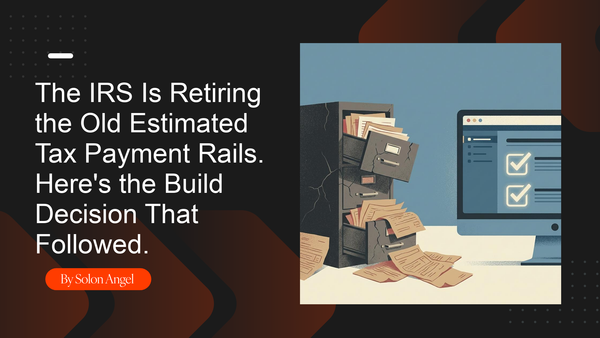
Executive Order 14247 ended IRS paper checks on September 30, 2025. New individual EFTPS enrollments closed on October 17. Later this year, EFTPS for individuals retires entirely. Federal tax deposits, payroll deposits, quarterly estimates, corporate deposits, all of it now has to move electronically through EFTPS, IRS Business Tax Account, or IRS Direct Pay. If a deposit does not move electronically, the business can be hit with a penalty unless it can prove reasonable cause. The IRS is not coming to help.
So the line is collapsing. The partner who wanted out is being pulled in.
A different partner, a regional firm a few states away, told me the older clients cannot do this on their own. Staff are walking them through portal logins. Staff are clicking the buttons for them. Staff are watching the screen on a Zoom call and reading the captcha out loud. Nobody decided to add this work to the firm. It just landed.
At the other end of the size spectrum, an advisor at a large wealth management firm told me their team goes directly to IRS and state websites and schedules every payment by hand. Fifteen to thirty minutes per client. Hundreds of clients per cycle. In a heavy quarter, close to a thousand payments. That is a person, full time, clicking. And that is before the mandate finishes its rollout.
So here is the moment we are actually in. Firms wanted less of the payment work. The federal government just made the workarounds illegal. The clients cannot operate the new system on their own. The work has to go somewhere. It is going to firms.
What this is really about is not software. It is who carries the consequence when a payment is late. Right now, when staff click on behalf of a client, the firm carries the consequence even if the engagement letter says otherwise. Penalties show up on the firm's reputation before they show up on the client's bill. Partners know this. That is why the partner I started with is trying to step back. He cannot.
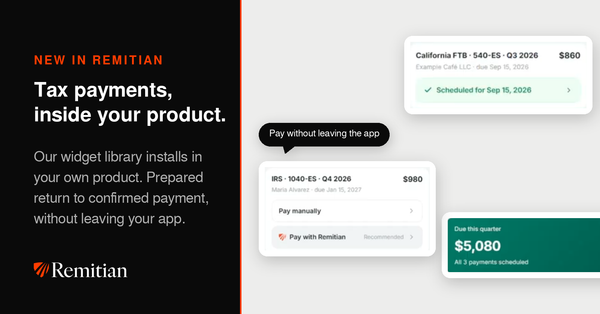
A reminder to advise clients better is not the answer. The technical analysis on the new rules already says practitioners are now responsible for guiding clients through Online Account, Direct Pay, and Business Tax Account. EFTPS Batch Provider is still around for pros making payments on behalf of clients. None of that solves the underlying problem. The underlying problem is that the firm is now in the payment flow whether it wants to be or not, and the firm has no infrastructure to schedule, track, confirm, and prove that every payment actually cleared.
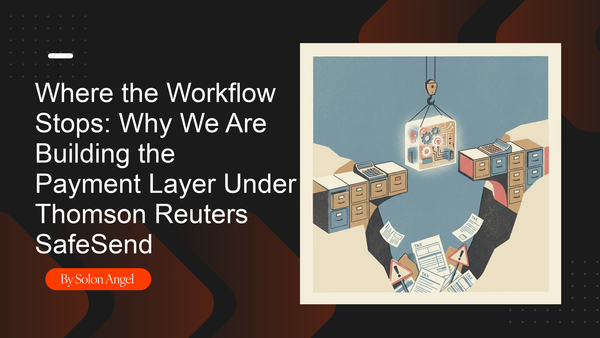
That is the gap. Filing has tooling. Workflow has tooling. Document management has tooling. Payments have a portal, a captcha, and a partner praying nothing bounces.
So I will say what I have been saying internally. There is no trying or figuring it out. Either firms have a system that owns payment execution end to end with proof, or they keep absorbing the liability quietly until the first bad miss makes it loud. One platform. Every tax payment. No penalties. That is the only version of this that ends well for the partner who wanted out.
He is still going to be in the payment flow. The question is whether he is in it with a system or with his fingers crossed.
Solon Angel is the Co-Founder and CEO of Remitian, the tax payment infrastructure platform for accounting firms, banks, and their clients.