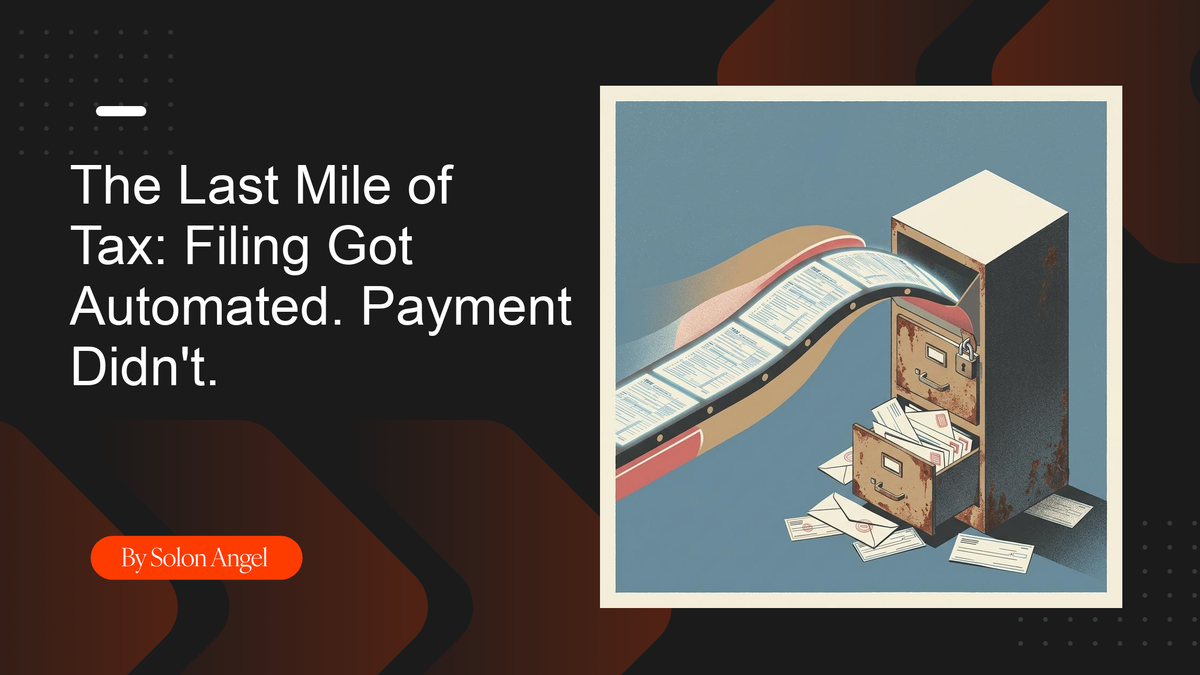
The Last Mile of Tax: Filing Got Automated. Payment Didn't.
Filing got automated decades ago. Payment never did, and most firms are still cutting checks by hand while the IRS quietly closes the rails they depend on. The compliance stack ends exactly where the real client work begins.
By Solon Angel
"It keeps getting longer and longer." That was a wealth advisor's line about the list of client tax payments his staff processes by hand. Over 150 entity payments in a single quarter. Roughly double that in individual payments across the IRS and a patchwork of state sites. The list does not stop growing. The headcount does not stop growing either.
That line has stuck with me because it captures something the tax tech industry quietly never fixed.
Filing got automated. Payment did not.
Think about the arc. Twenty years ago, prep was paper. Returns were typed, printed, signed, mailed. Then software came in and ate the prep workflow. Then e-filing ate the submission step. Then document gather, client portals, review, and delivery all got their own layers. By 2026, the rallying cry from the big platforms is "integrated ecosystems," and Thomson Reuters' own 2026 outlook describes a smooth pipeline from document intake to client delivery.
Read that pipeline carefully. Prep, review, delivery. Payment is not in it. It is treated as adjacent. A thing that happens somewhere else, by someone else, using somewhere-else tools.
That gap shows up in every conversation I had this week.
A specialty indirect-tax vendor that serves large enterprises told me their calculation, certificate, and licensing software is strong. Then they walked me through how business-license payments actually move through their shop. Funding requests. Manual matching of payments to filings. Checks pushed out through their own treasury process. They sell the calculation layer. They eat the payment layer in operations. The product they ship and the work they do are not the same product.
A large multi-state CPA firm told me their software handles extensions and returns fine, but estimated payments are a "huge pain." Quarterly. Recurring. Schedule-driven. The most automatable cash movement in the tax calendar, and many of the underlying calculations are still living in spreadsheets while the prep workflow next to them is fully automated. A mid-size firm in the northeast told me their main suite cannot even adjust an estimated payment once it has been submitted, and they have stopped waiting for the legacy stack to fix it.
A large trust company put it in the most literal terms. They handle tax payments for over a thousand clients, roughly a quarter of whom rely on them for that service. The team is cutting paper checks by hand. They are also worried, out loud, that the rails they have been using for elderly clients for decades may not be permitted much longer.
They are right to worry. Executive Order 14247 has the IRS moving payments to and from taxpayers off paper checks, with milestones landing through 2026. EFTPS closed to new individual enrollments in October 2025. All individual users are being transitioned off EFTPS later this year. The rails are changing under firms whose workflows assumed the rails would never change. Add Wolters Kluwer's own observation that accounting teams can spend hours logging into state portals, re-entering payroll data, and downloading confirmation receipts across fifty different systems, and the scale of the problem comes into focus.
This is what I keep telling the team. The last mile of tax was never solved. It was deferred. Filing got automated because the IRS forced the issue with e-file mandates. Payment did not get automated because the IRS left the rails alone. Now the IRS is touching the rails, and the deferred work is finally due.
The firms feeling this most acutely are the ones doing the most volume. Wealth managers, trust companies, multi-state CPA firms, indirect-tax shops. They are absorbing payment execution as a service to their clients, then performing it by hand because the tools they bought were never designed to perform it. That is not a small-firm problem. It is structural.
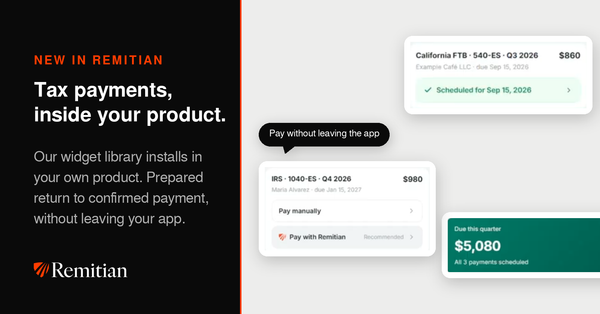
What changes from here is simple in shape and hard in execution. The compliance side and the payment side stop being two stacks held together by a treasury team and a spreadsheet. One workflow. One audit trail. One source of truth for what is owed, what was paid, when, by whom, against which filing.
I cannot stop thinking about what these conversations add up to. The firms we are talking to are not asking for a feature. They are asking for the missing layer of an industry that forgot to finish itself. And the deadline for finishing it is no longer theoretical.
Solon Angel is the Co-Founder and CEO of Remitian, the tax payment infrastructure platform for accounting firms, banks, and their clients.