The Executive Order Nobody in Accounting Is Reading
The Executive Order everyone is reading as a crypto win actually clears the regulatory path for embedded payment infrastructure in accounting and tax. Most firms have not noticed yet, and the platforms quietly embedding payments are about to lap them.
By Solon Angel
Did you read yesterday's Executive Order?
Probably not. Most of the coverage will frame it as a crypto win. Some will mention digital banking. Almost nobody is going to point out the part that actually changes the ground under accounting firms and tax software companies.
The EO does one specific thing buried inside its language. It tells every federal financial regulator to find and remove rules that block fintech firms from partnering with banks. It gives them 90 days. It also asks the Federal Reserve to evaluate direct payment access for non-bank payment companies, with a 90-day clock on each complete application. And it explicitly names payment processing as a core fintech activity covered by the order.
That last part is the one nobody is going to talk about.
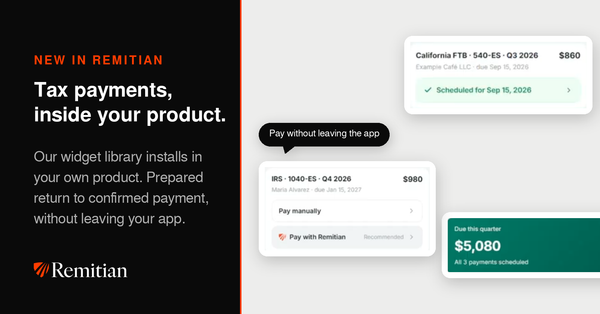
I have been on calls every week for the past two months with banks, ecommerce platforms, and tax software vendors. Different companies, same conversation. They want the routing engine. They want the API. They want the compliance lift. They do not want another portal their customers have to learn. A senior product leader at one of those calls put it plainly. The dream is that their customers never see us at all. They just want their platform to support tax payments. Quietly. Embedded.
That model has been technically possible for years. What slowed it down was regulatory friction between fintech infrastructure and the financial institutions on the other side of the partnership. The EO is aimed straight at that friction. Section 4 hands the Federal Reserve a specific assignment to operationalize direct payment access for non-bank payment companies. Governor Waller has already signaled that skinny master accounts should be live by the end of this year. The Fintech Trade Association has been pushing for exactly this for years, and a presidential order is now behind the push.
Sit with the implication for a second. Embedded payment infrastructure for tax and accounting just got cleaner air in the underlying plumbing. The companies building that infrastructure can move faster, partner faster, and ship faster than they could last month. That is a bias to action moment for everyone serious about this market.
Here is the part that bothers me. Accounting firms are not paying attention. They are still wiring client tax payments through trust accounts, still chasing IRS confirmations through portals, still treating payment movement as an administrative chore instead of a regulated financial activity. A lot of them do not realize they are operating in a regulatory gray zone right now. When the partnership flywheel starts spinning between platforms and infrastructure providers, the firms that have not modernized their payment workflow are going to find themselves on the wrong side of a very fast curve.
The ecosystem play moves first. One alliance leader I spoke with described the math plainly. A single integration into a network of dozens of firms beats dozens of individual sales cycles. Multiply that by every software platform that now has cleaner regulatory air to embed payments. The distribution looks nothing like the old one-firm-at-a-time motion.
So if you run a firm, the question is simple. Are you the one waiting for your software vendor to tell you tax payments are handled now, or are you the one already asking them when. The first group gets there eventually. The second group gets there this quarter.
I am paying attention because the operational reality of our partnership pipeline just changed. Less friction means more deals close. More deals close means more firms quietly get modern payment rails through software they already use. That is the real story.
Read the order. Then read it again.
Solon Angel is the Co-Founder and CEO of Remitian, the tax payment infrastructure platform for accounting firms, banks, and their clients.