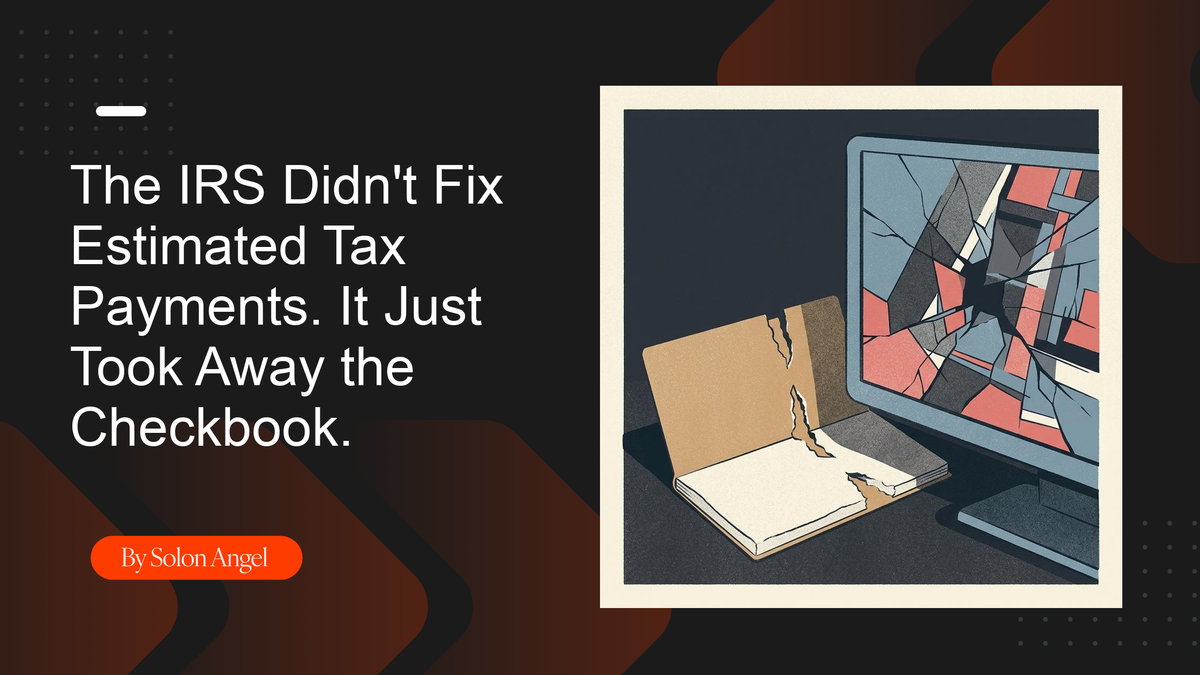
The IRS Didn't Fix Estimated Tax Payments. It Just Took Away the Checkbook.
Executive Order 14247 phased out federal paper checks, pushing firms onto Direct Pay and EFTPS replacements built for a single person paying once, not a firm running hundreds of payments a month. The mandate arrived. The firm-grade replacement did not.
By Solon Angel
The IRS took away the checkbook and called it progress.
Executive Order 14247 kicked in on September 30, 2025, and paper checks to and from the federal government are on their way out. EFTPS stopped accepting new individual enrollments on October 17. Every estimated tax payment your clients used to mail is now supposed to move electronically. The official story is that the free tools already solved this. Direct Pay is right there. IRS Online Account is right there. What more does a firm need?
A lot, it turns out.
Direct Pay was built for one person paying one bill one time. It makes you re-enter identity information for every single payment. It has no dashboard. No client roster. No way to pull confirmations later when a partner asks why the June installment for a specific entity is missing. EFTPS, the thing practitioners actually used, is being wound down for individuals through 2026. And it still fails name-match verification over a middle initial. Practitioners have been complaining about that in forums for years. The government's answer was to remove the option, not fix the tool.
Last week a mid-size CPA firm walked me through their current setup. Most client payments still go out as mailed vouchers and paper checks. They told me plainly that the IRS pulling back on checks is what forced them to start looking for an electronic replacement. Not efficiency. Not ambition. A mandate. And what they wanted was simple. One place to pull payment confirmations, because clients drag their feet giving proof at year-end and reconciliation eats their souls. That is not an exotic ask. It is the baseline of any firm-grade workflow. And it does not exist in the free tools.
Another firm, smaller, told me interest in electronic tax payment tools spikes every time the IRS applies pressure and cools the second that pressure eases. Their urgency is entirely externally driven. That is the market. Firms are not sitting around dreaming of automation. They are getting pushed, then pulled back, then pushed again, and every cycle costs them.
Then there is a firm doing about 300 payments a month. On the two monthly deadline days, one staff member spends most of the day physically driving from bank to bank to submit checks. Three hundred payments. A car. A person. In 2026. That is the last mile of tax payment for a real firm at real volume, and no one at the IRS built a tool that touches it.
Meanwhile Wolters Kluwer is out here reminding everyone that post-Wayfair, a mid-size firm with multi-state clients is tracking hundreds of jurisdiction combinations. Each state has its own portal, its own credentials, its own payment types. The federal system is one node in that graph. Electronic-only mandates do not simplify this. They multiply it. Every jurisdiction that flips off paper adds another portal a firm has to log into, another set of credentials to rotate, another confirmation to chase.
So no, the IRS did not fix estimated tax payments. It removed the fallback and pointed at a set of consumer tools that were never meant for firms. That is not modernization. That is decommissioning without a replacement.
The firms winning right now stopped waiting for the government to build the thing. They picked a payment layer that speaks to every jurisdiction, holds client data once, generates confirmations automatically, and does not require a staff member with a car. Everything else is a workaround dressed up as a workflow.
I keep saying this on calls and I will say it again here. Distribution and responsiveness win. The firms that answer their clients inside an hour, with a real receipt in hand, will keep those clients. The ones still promising to mail something in are already losing them.
We are building for the second group to catch up. That is the whole job.
Solon Angel is the Co-Founder and CEO of Remitian, the tax payment infrastructure platform for accounting firms, banks, and their clients.