The IRS Is Retiring the Old Estimated Tax Payment Rails. Here's the Build Decision That Followed.
The IRS is dismantling the tax payment rails firms have relied on for decades, and the replacements were never designed for how firms actually move client money. Paper checks are gone, EFTPS for individuals is winding down, and the last mile is up for grabs.

By Solon Angel
"We had one person signing in and out of ninety-four trust accounts to make federal payments, with a partner watching every single click." That was a back office accountant at a multi-entity family office describing their current setup on a call last month. Ninety-four logins. One person. One partner supervising. That was their process for handling IRS estimated tax payment obligations across their trust book, and it was the process before the IRS started pulling the rails out from under everyone.
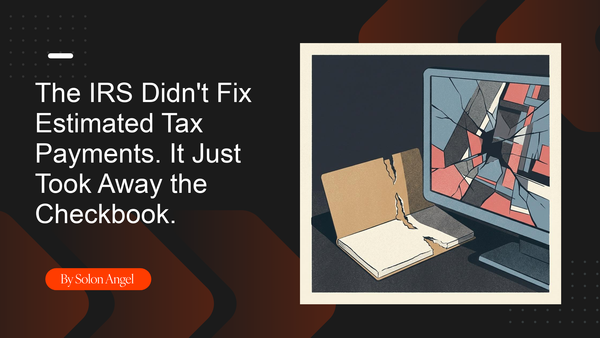
On September 30, 2025, the IRS stopped issuing paper refund checks. On October 17, they closed new individual EFTPS enrollments. Late 2026, EFTPS for individuals disappears entirely and everyone gets pushed onto Direct Pay or an IRS Online Account. Executive Order 14247 is not a proposal. It is a live migration of every IRS estimated tax payment your clients still make on paper, and firms are being told to figure out the electronic on-ramp on their own.
Here is what firms are actually saying on calls right now. A mid-size CPA firm told us most of their clients still mail vouchers and checks, and the paper check phase-out is the only reason they started looking for a new payment solution. A regional firm with an older client base said the same thing, but framed it as an opportunity to offer a managed payment service before their clients hit the wall. Nobody is doing this because they want to. They are doing it because the government told them they have to.
And the replacement rails are not clean. Practitioners keep hitting ID.me verification failures, account lockouts, records-do-not-match errors, and multi-hour waits on IRS support lines. Direct Pay guest is the workaround, which is a fancy way of saying the fallback for a mandated system is another one-off web form with no state and no receipt trail. The rail change is happening whether the ecosystem is ready or not.
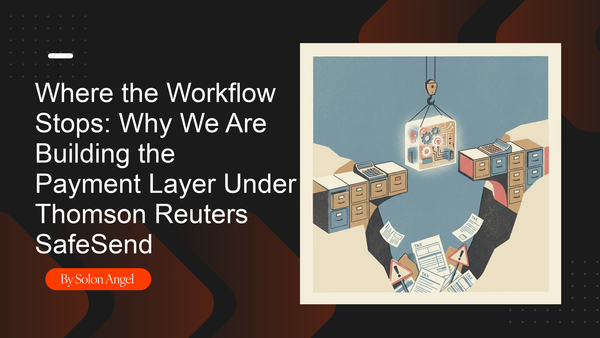
This is where the build decision came in. We looked at the mess and asked a simple question. Is the last mile of tax payments something we buy, wrap, or build. Buying meant renting somebody else's ACH connections, which meant renting their limits, their cutoff times, and their willingness to serve accounting firms specifically. Wrapping meant sitting on top of the same fragmented portal layer that firms already hate. Building meant going all the way down to ACH credit and debit flows and the banking ledger underneath.
We chose build. The reason is boring and it is also the point. Do the hard things nobody else can copy easily. That is moat. If the payment layer is a thin abstraction over somebody else's plumbing, any competitor with a checkbook can replicate it in a quarter. If the payment layer is your own ledger, your own rails, your own compliance surface, the copy cycle is measured in years. In a market where the IRS is forcing every firm to pick a new payment path right now, that time gap decides who is still relevant in 2028.
The upside for firms is what makes the build worth the pain. Every one of the calls above described tax payment execution as a cost center. Somebody's time, somebody's stress, a partner's oversight, and no line item on any invoice. The moment payment is a managed service the firm delivers, it becomes a revenue line. That is not a slide. That is a firm that used to eat the labor of ninety-four logins now billing for the service that replaces those logins.
I do not think most firms will build their own rails. I do not think they should. But I do think the ones that pick their payment layer carefully in the next twelve months are the ones that keep their clients, and I would rather be the layer they pick because we did the hard work than the layer they leave when a real one shows up.
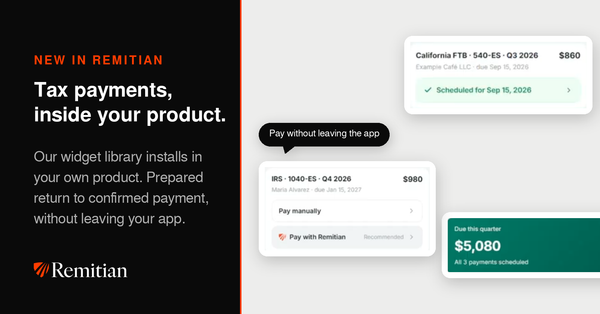
Solon Angel is the Co-Founder and CEO of Remitian, the tax payment infrastructure platform for accounting firms, banks, and their clients.