Where the Workflow Stops: Why We Are Building the Payment Layer Under Thomson Reuters SafeSend
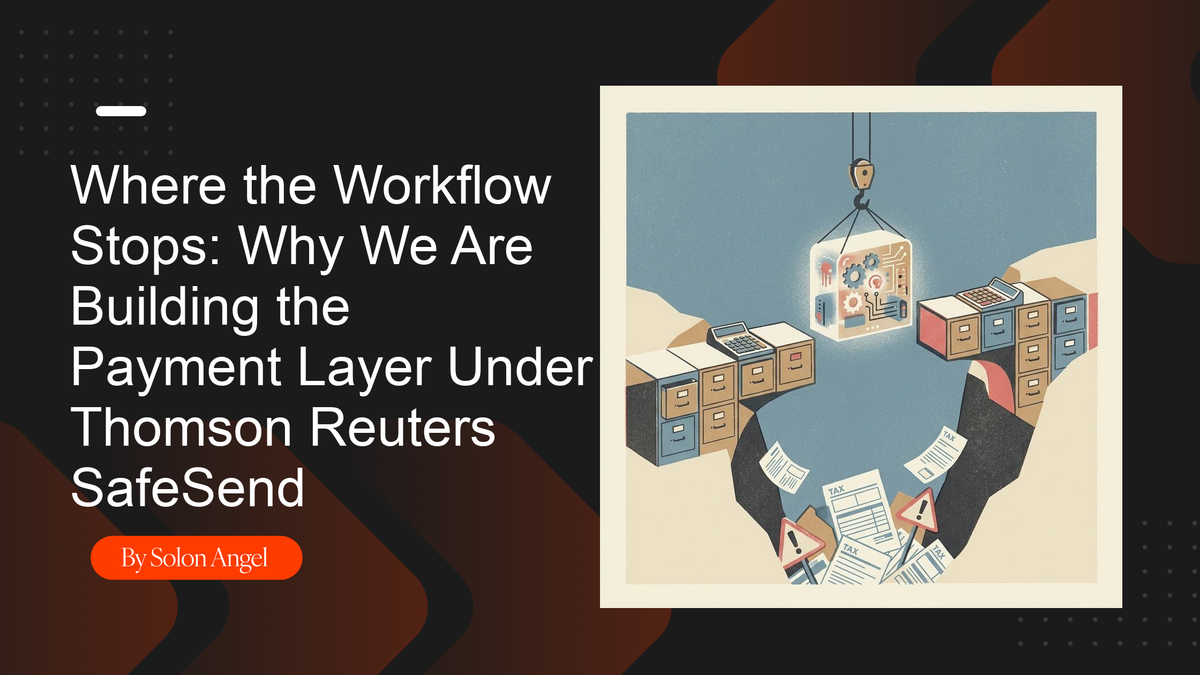
For two quarters, buyers on demo calls have described the same broken shape: workflow, delivery, and prep run smoothly, then the tax payment falls out into a portal nobody wants to log into. Here is why we built the payment layer under Thomson Reuters SafeSend.
By Solon Angel
Over $100 million in tax payments moved through us in one season, across more than 60 US jurisdictions. That is a number I care about far less than the one sitting next to it. Roughly 70 percent of the top-100 US accounting firms already run their tax delivery through Thomson Reuters SafeSend. Every one of those firms hits the same wall at the same moment. The return is prepared. The engagement letter is signed. The K-1s are delivered. Then the client is pushed out to IRS Direct Pay, or a state portal, or a checking account and a memo line, to actually move the money. That final step is where the entire workflow leaks.
For two quarters now, on demo call after demo call, buyers have described the exact same shape. They have workflow. They have delivery. They have prep. The payment happens somewhere else. Trust leaks out there. Audit trail leaks out there. Firm hours leak out there. Nobody sold them a broken workflow. They stitched one together because the market never gave them anything else.
One small firm told us their clients keep asking them to just take the whole payment step off their plate. Not deliver the return. Not remind them of a deadline. Actually own the movement of the dollars. The firm's delivery layer runs fine. The payment is the piece that keeps forcing a phone call, a follow-up, a screenshot from a portal that half the clients cannot find on their own. A small-firm operating-system builder in a totally different corner of the market told us the same thing in different words. Their pitch is that accountants should stop bouncing between the main tool, the tax tool, and a legacy processor that redirects everyone out mid-flow. Same wall. Same leak.
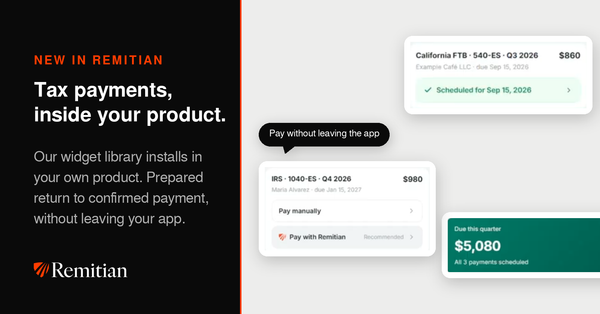
Then move up market. A national practice-management platform mapped the architecture for us on a partnership call, unprompted. Practitioner side on the API. Client side embedded in the branded portal so the client never leaves the tool to approve. IRS confirmations pushed back over webhooks so the record of what got paid lives inside the tool the firm already trusts. A top-tier US firm evaluating an enterprise pilot said the same thing from the buyer's side. They want the client to stay inside their branded ecosystem for the entire tax lifecycle, and they called the payment step the awkward part of the process today. Their preference is that the client stays the final approver while the firm orchestrates the moment around them, and the firm never becomes the party that touches client money.
Every one of those calls, top to bottom, points at the same missing piece. Every serious buyer is drawing the same architecture on the same whiteboard. Consolidation is what the market is asking for out loud. Thomson Reuters is naming end-to-end workflow among the top tax technology trends for 2026. CPACharge and SafeSend embedded invoice payment inside the SafeSend workflow last year, which tells you the direction of travel is unmistakable. Firm-invoice payment got solved before actual tax remittance did. That is a strange order of operations if you sit with it for a second. It also tells you exactly where the market ran out of runway.
So we built the payment layer underneath Thomson Reuters SafeSend. Preparation, delivery, and e-signature already live there. Now the actual remittance to the IRS and to the states lives there too. The workflow finally runs end to end inside one tool. The client never leaves at the exact moment a dollar amount is on the screen. The firm never has to be the party moving client money. The confirmations land back in the same place the return did.
I know how it sounds when a founder says the market has been waiting for their thing. So I will not pretend the number on the door, $100 million, is anything but a start. We are just at 0.01 percent getting started. The point of this launch is not the announcement. The point is what happens the first time a client hits pay inside the tool they were already going to sign in. If that moment feels boring, we did our job.
I am proud of the team for building the true final mile of tax. Now the work is to make it invisible.
Solon Angel is the Co-Founder and CEO of Remitian, the tax payment infrastructure platform for accounting firms, banks, and their clients.