Your Accounting Software Just Became a Liability
CCH. UltraTax. ProConnect. SafeSend. Excellent at what they do. But they're not payment infrastructure. The moment money needs to move, they hand the baton to a spreadsheet and a prayer.

Let me say something that's going to upset a few people.
The tax software you've been loyal to for a decade? The one your team knows inside out? It may be the single biggest risk to your firm right now.
Not because it's bad software.
Because it stops at the wrong place.
The IRS just changed the rules. Most firms haven't noticed.
Executive Order 14247 mandated that the federal government stop issuing paper checks by September 30, 2025. Done. Over. And the direction for inbound payments is the same destination. Electronic only. The IRS confirmed it. The timeline is just "as soon as practicable."
That's not a maybe. That's a when.
Over 830,000 notices have already gone out to taxpayers whose refunds are frozen because they didn't have direct deposit on file. Treasury called it a modernization. I call it a warning shot.
And yet, in call after call, firm after firm, I keep hearing some version of the same thing:
"We usually have clients do it themselves. It's unpredictable."
Here's what that actually looks like in practice.
A 55-person CPA firm told us their biggest pain point is managing extension payments for pass-through entities across multiple states. Tracked in spreadsheets and email. No standard process.
A healthcare company managing over 100 entities has 48 hours to execute payments after treasury approves, because state revenue websites don't allow advance scheduling and treasury wants to hold cash as long as possible. They nearly rejected an entire platform because a previous system sent payments to their bank with zero identifying metadata. Nobody could figure out which payment belonged to which entity. Treasury exploded.
A top-10 accounting firm walked into a meeting with us this month specifically because their wealth advisory team processes hundreds of families quarterly through Schwab and that workflow is about to stop working. Schwab is ending check issuance to the IRS for wealth management clients on June 15. Their current process of requesting checks from Schwab, tying them to vouchers, and mailing to the IRS was flagged on the call as a potential AML violation.
And let’s not forget these routing numbers put in excel spreadsheets unprotected.
These are not outliers. This is the profession.
The dirty secret of tax software.
CCH. UltraTax. ProConnect. SafeSend. They are excellent at what they do.
They are not payment infrastructure.
They were never designed to be. They prepare the return. They deliver the return. And then, at the exact moment money needs to move, they hand the baton to the client, a government portal, a spreadsheet, and a prayer.
The firm has no visibility, no control, and no audit trail the moment that payment leaves the building.
That's not a gap. That's a gaping hole.
"But the IRS accepts checks for now."
Yes. For now.
The firms paying attention aren't waiting for the deadline. They're building the infrastructure now.
The real question isn't "should we go electronic."
It's already electronic. You just don't control it.
Your clients log into EFTPS if they remember their password. They go to each state portal separately. They make payments you'll only find out about next filing season, when they can't prove they paid. Or worse, they paid the wrong amount, to the wrong year, and nobody caught it.
Your clients are those 830,000 people with frozen refunds.
What this actually requires.
Not another dashboard. Not another login. Not a portal you have to beg clients to use.
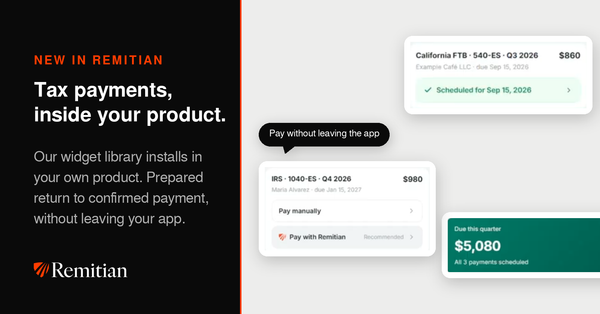
A system where the return is filed, the payment is extracted automatically, it routes to the right authority with the right metadata, treasury approves it, the bank statement reconciles cleanly, and everyone has a receipt.
The bank reconciliation point matters more than people realize. Payment infrastructure that can't tell your treasury team what a transaction was for is not infrastructure. It's noise.
The firms that figure this out in 2026 will own the next decade.
Every major accounting firm in North America is walking into the same wall this year.
The paper check is dying. Electronic payments are mandatory. State portals are fragmented. Clients are terrible at self-service. And the liability for missed or misapplied payments lands on the firm.
This is the moment where operational infrastructure becomes a competitive advantage.
The firms that solve it will retain high net worth clients who demand white glove service. They'll scale without adding headcount. They'll have audit trails that protect them when something goes wrong.
The firms that don't will keep spending unbillable hours chasing payments that were already late before anyone noticed.
I'm not writing this to sell you something.
I'm writing this because I've spent the last three years talking to accountants, wealth managers, community banks, and enterprise tax teams. The pattern is the same everywhere.
The last mile of tax compliance is the least automated, least visible, and most legally exposed part of the entire workflow.
That's the problem we're fixing.
If you're curious what that looks like in practice, I'm happy to show you.