Where Tax Payments Still Move on Paper: The Local Long Tail Nobody Built For
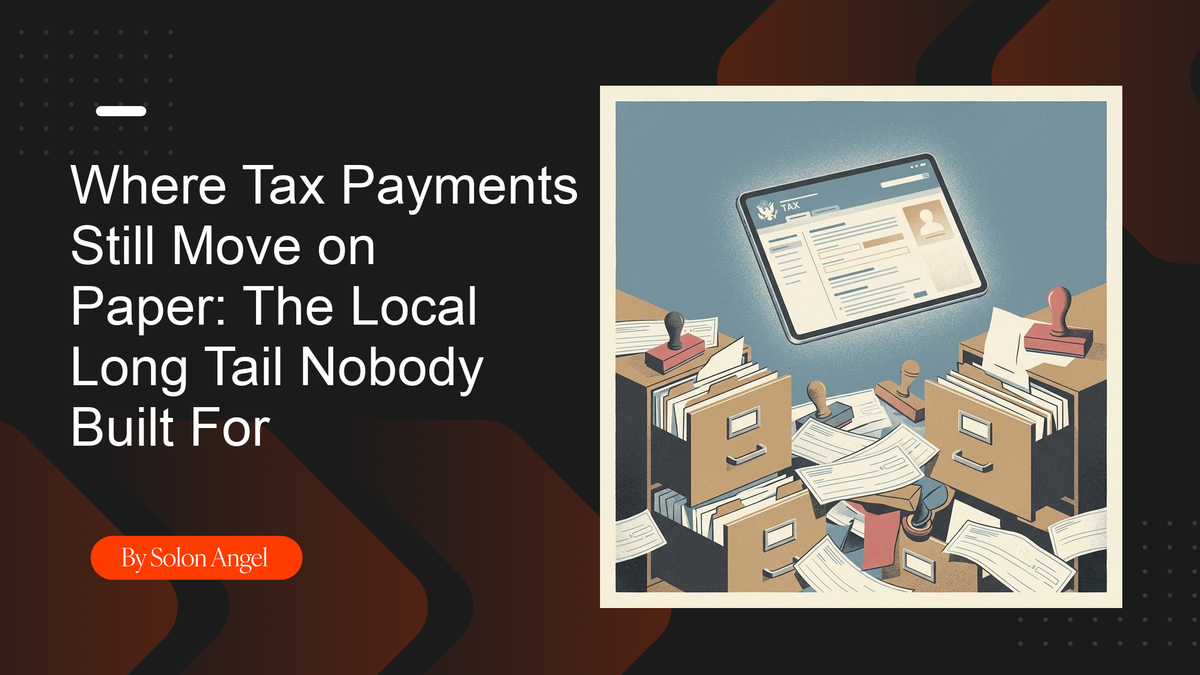
Federal payments are going fully electronic on a schedule. The local layer isn't. Firms describe city licenses paid by check, bank portals walked one client at a time, and entity mismatches at state DORs that quietly eat their senior staff hours.
By Solon Angel
"We spend ten to thirty minutes per client meeting walking people through bank portals. We can't set up recurring tax payments. The rules won't let us." That is a practitioner at a CPA firm with multi-entity corporate clients, describing how their week actually goes. Not the parts that make it into pitch decks. The parts that eat the day.
This is what tax payment modernization looks like in 2026 once you get below the federal layer. Executive Order 14247 has Treasury and the IRS moving toward fully electronic federal payments, with paper refund checks phasing out as of September 30, 2025 and individual EFTPS enrollments winding down through 2026. From thirty thousand feet, federal payments look modern. Then you call ten firms and ask them how the local layer works, and the answer keeps coming back the same.
One mid-size tax-tech firm focused on indirect and license compliance described a single client with somewhere between 1,500 and 2,000 business license payments a year, spread across cities and counties in multiple U.S. regions. Many of those jurisdictions still want a check. The firm has strong calculation and certificate software upstream. None of it touches the payment step. That happens inside their treasury, through funding requests, manual matching, and internal check runs.
A trust company with around 1,100 managed high-net-worth relationships said about a quarter of those clients use the firm for tax payments. Those payments are cut as paper checks. The team is worried about what happens when federal restrictions tighten further, because their elderly clients are never going to log into a federal direct-pay tool. The check workflow is not a small-firm artifact. It is sitting inside private wealth operations at scale.
A regional accounting firm where roughly three quarters of the book is multi-state described the worst part of their week as multi-entity clients getting the entity identifier wrong on a payment. The state takes the money under the wrong taxpayer. The firm spends senior staff time on the phone with departments of revenue, undoing one payment and re-executing it correctly. The bottleneck is not the firm's internal process. It is the jurisdiction-by-jurisdiction portal mechanics they have to work through.
Look at where the industry's external reporting points and the pattern matches. Thomson Reuters and Wolters Kluwer have flagged that 2026 nexus enforcement is getting more sophisticated, that only about 37 percent of firms have invested in new AI-powered tooling in the past year, and that multi-state automation gaps at the locality level are the operational risk firms keep underestimating. Wealth platforms, meanwhile, are racing to embed tax workflows for advisors serving high-net-worth clients, with payment handling increasingly priced as a billable service rather than a back-office cost.
So here is what keeps surfacing on these calls. The modernization story everyone is telling is a federal story. The pain is local. The check that pays a city business license. The portal in a county that does not accept ACH for forward-dated payments. The entity identifier mismatch that puts a six-figure remittance under the wrong sub-entity. Nobody is building for that layer, because the surface area is huge and unsexy and changes one jurisdiction at a time.
That is where firms are losing the most non-billable hours per client. That is where the next round of modernization actually has to happen. The federal piece is on a schedule. The long tail is on nobody's.
I keep telling the team we do not need to fight the upstream tax software on their own turf. We need to be the thing that quietly handles the part of the workflow they were never going to fix, because their business is calculation, not remittance. The firms we talk to keep telling us the same story. I am just writing it down.
Solon Angel is the Co-Founder and CEO of Remitian, the tax payment infrastructure platform for accounting firms, banks, and their clients.